

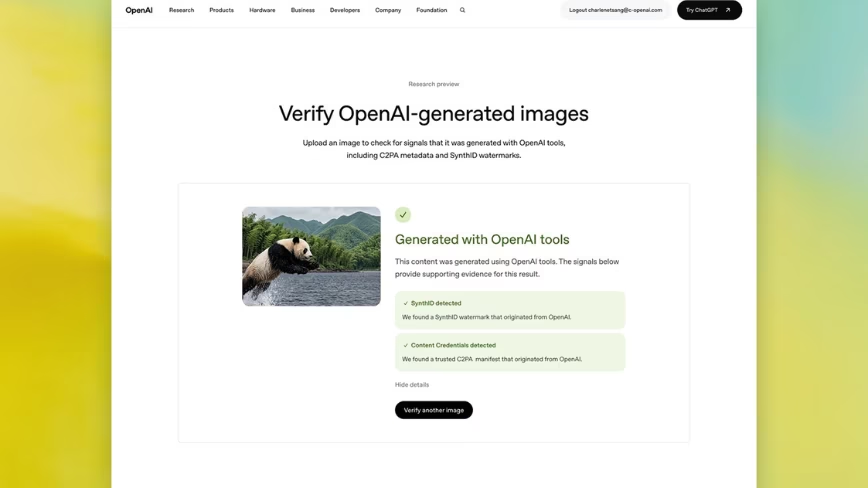
OpenAI has announced two new measures designed to help the public determine whether an image was created by its AI models. The company is formally joining the Coalition for Content Provenance and Authenticity (C2PA) open standard while simultaneously partnering with Google to embed its invisible SynthID watermark across OpenAI’s image outputs. These moves represent a meaningful step toward transparency in AI-generated imagery, though their scope remains limited to content produced by OpenAI’s own tools.
Two systems, one goal
The C2PA standard, founded in 2021 by Adobe, Arm, the BBC, Intel, Microsoft, and Truepic, attaches metadata to a file that records its origin and any edits made along the way. It has since been ratified as an ISO standard and adopted by a range of Google products, though adoption remains inconsistent across the wider industry. Because the C2PA signal sits in a file’s metadata, it is clearly accessible, which also means it can be stripped or manipulated. The standard is most reliable among trusted users and platforms that choose to preserve it.
SynthID, developed by Google DeepMind, takes a different approach. Rather than attaching readable metadata, it embeds an invisible watermark directly into the image. That watermark is designed to persist even through screenshots, resizing, compression, and other forms of digital manipulation, making it far harder for bad actors to remove. The two systems are intended to complement each other. As OpenAI explained, watermarking offers durability through transformations such as screenshots, while metadata provides richer contextual information than a watermark alone. Together, the company argues, they create a provenance system more resilient than either layer would be independently.
A public verification tool, with caveats
Alongside the announcement, OpenAI is previewing a public verification tool that checks for both C2PA credentials and the SynthID watermark. The tool will allow anyone to upload an image and determine whether it was generated by one of OpenAI’s models. For now, the tool only covers images produced by OpenAI’s products, though the company has said it hopes to expand its scope over time. That is a significant limitation. The flood of AI-generated imagery circulating online comes from a vast ecosystem of tools, many of which have little incentive to adopt provenance standards. OpenAI’s new measures can help ensure the company is not contributing to the problem, but they will do nothing to address images from less scrupulous sources.
Part of a broader push
The announcement arrives amid growing concern from governments and civil society about the role of AI-generated content in misinformation and public discourse. C2PA has attracted more than 6,000 members and affiliates as of early 2026, and its specification reached version 2.1 last year. OpenAI has now joined the coalition’s steering committee, positioning it alongside Adobe, Microsoft, and other founding members in shaping the standard’s future direction. Google, for its part, has been expanding SynthID adoption across its own products. The partnership with OpenAI marks the first time the technology will be embedded in a major rival’s outputs, a notable instance of cross-industry collaboration on AI safety and transparency.
The provenance ecosystem is still nascent. While C2PA provides a standard for metadata, it depends on the willingness of platforms to preserve that metadata. Social media sites, image hosts, and messaging apps often strip metadata to save space or protect privacy. This undermines the reliability of C2PA as a standalone solution. SynthID’s watermark offers a more robust alternative, but it requires deep integration at the generation stage. Not every AI image generator has the resources or incentive to adopt it. OpenAI’s move sets a precedent, but the industry as a whole remains fragmented.
From a technical perspective, SynthID is a remarkable achievement. Google DeepMind designed it to be imperceptible to the human eye while remaining detectable by algorithmic tools. The watermark is embedded in the pixel values of the image using a neural network that adds a subtle but consistent pattern. This pattern survives common transformations such as cropping, color adjustments, and even screenshots, making it significantly harder to remove than traditional watermarks. However, no watermark is foolproof. Sophisticated attackers can attempt to add noise or adversarial perturbations to distort the signal. The cat-and-mouse game between watermarking techniques and removal attacks is ongoing, and SynthID is not immune to future advances in adversarial machine learning.
The C2PA standard, on the other hand, provides a chain of custody for digital content. When an image is created or edited, the tool records a cryptographic signature that can be verified later. This allows consumers to see not only that an image was generated by AI, but also by which model, when, and what modifications were made. However, the standard relies on trust in the signing entity. If the signing key is compromised or if the user deliberately strips the metadata, the provenance information is lost. Moreover, mainstream platforms like Instagram, Twitter, and Facebook do not currently honor C2PA signals in a meaningful way, though some are exploring the idea. The effectiveness of C2PA depends on widespread adoption across the entire content ecosystem.
OpenAI’s decision to support both standards is a pragmatic approach. By combining durable watermarks with rich metadata, the company aims to cover a wider range of use cases. For example, a news organization verifying an image from a user-generated content tip can check the C2PA metadata for detailed provenance information. If the metadata is missing, the SynthID watermark still provides a fallback to confirm the image’s origin. This dual-layer system significantly raises the bar for deepfake misuse. However, it is not a magic bullet. The verification tool is currently only available in preview and may not scale to handle the volume of images generated daily. OpenAI has not disclosed performance metrics or false positive/negative rates, so independent evaluation is still needed.
The broader implications extend beyond OpenAI and Google. Regulators worldwide are grappling with how to label AI-generated content. The European Union’s AI Act mandates that AI-generated images be clearly marked, and the US, UK, and other countries are considering similar legislation. OpenAI’s adoption of C2PA and SynthID aligns with these regulatory trends, potentially easing compliance for its customers. It also puts pressure on competitors like Meta, Stability AI, and Midjourney to adopt comparable measures. The industry’s fragmented response to provenance remains a major hurdle. Without uniform standards, bad actors will seek out the weakest links.
Another dimension is the impact on creators and rights holders. Watermarking can help artists protect their work from being used without consent to train AI models, though SynthID specifically targets the image’s origin rather than authorship. There is ongoing debate about whether provenance systems can be used to enforce copyright. So far, C2PA and SynthID are designed for attribution, not for rights management. Artists may need additional tools to assert ownership and control over derivative works. Nonetheless, any system that increases transparency around AI-generated content is a net positive for the information ecosystem.
In practice, the success of OpenAI’s initiative depends on user education. Many people are unaware of what metadata or watermarks are, let alone how to check them. The verification tool is a step in the right direction, but it requires users to actively upload an image to a website. Integrating the check into browsers, social media platforms, or operating systems would be far more effective. OpenAI has hinted at future partnerships that could embed the verification into workflows, but no concrete plans have been announced. Until then, the tool will primarily serve journalists, fact-checkers, and researchers who know how to use it.
There are also privacy considerations. Uploading an image to a third-party verification tool potentially exposes the image to OpenAI’s servers. While the company likely logs queries for improvement, it should clearly state its data handling policies. Users of the verification tool need assurance that their images will not be used for training or stored indefinitely. Transparency about these practices is essential for building trust in the provenance system.
The timeline for the rollout is also important. OpenAI is previewing the verification tool now but has not set a firm date for general availability. The SynthID integration will be applied to all new images generated by DALL-E 3 and ChatGPT’s image generation capabilities. Existing images will not be retroactively watermarked, meaning there will be a transitional period where some OpenAI-generated images lack the dual-layer protection. This may create confusion if older images circulate alongside newly watermarked ones. OpenAI has acknowledged this and recommends treating all images with skepticism until provenance becomes standard.
From a competitive standpoint, OpenAI’s partnership with Google is notable. The two companies are often rivals in AI development, but they found common ground on safety. This cooperation may encourage other firms to put aside competitive differences and work together on provenance. However, it also raises concerns about consolidation of power. If a small number of companies control the dominant watermark standards, they could set terms that disadvantage smaller players. Open standards like C2PA are designed to prevent vendor lock-in, but in practice, the most influential companies shape the direction. OpenAI’s seat on the steering committee gives it significant influence over the future of C2PA, which could be beneficial if used responsibly.
Critics may argue that these measures are too little, too late. AI-generated imagery has already been used to create convincing deepfakes of politicians, celebrities, and ordinary people. The technology is advancing faster than the safeguards. OpenAI’s move is a step forward, but it does not address the root cause: the ease with which anyone can generate deceptive imagery using free tools. Provenance systems are a defense, not a deterrent. They rely on the assumption that users care about authenticity. In communities where misinformation spreads rapidly, provenance signals may be ignored or weaponized. For example, a bad actor could claim that a real image is AI-generated by pointing to a missing watermark, creating doubt. This phenomenon, known as the “liability of provenance,” requires careful public communication.
In summary, OpenAI’s dual-layered approach is technically sound and strategically important. By joining C2PA and integrating SynthID, the company is taking responsibility for the imagery its models produce. The public verification tool offers a practical way to check authenticity, though its current limitations underscore the need for widespread industry adoption. The partnership with Google on SynthID is a rare cross-industry collaboration that could set a new standard for safety. Yet the battle against AI-generated misinformation will not be won by provenance alone. Education, regulation, and media literacy are equally crucial. OpenAI’s announcement is a necessary but insufficient step in the ongoing effort to preserve trust in digital content.