

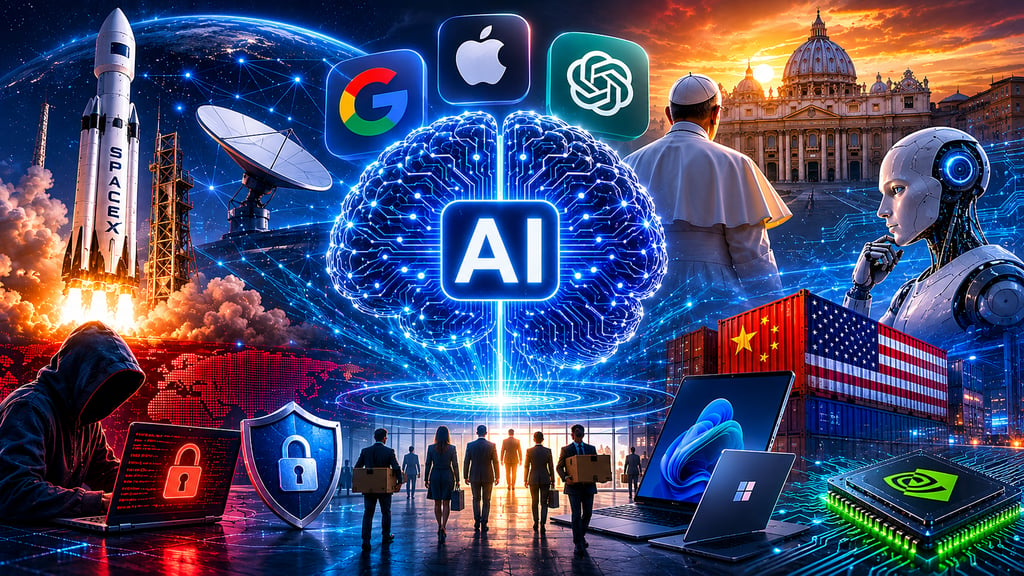
This week in technology was defined by transformative AI product overhauls, blockbuster IPO filings, and escalating cyberthreats. SpaceX filed for a record-setting IPO, Google unveiled its next-generation AI models, and the Vatican entered the AI ethics arena. Meanwhile, security breaches exposed sensitive data, and industry shakeups highlighted the complex interplay between AI adoption, workforce restructuring, and investor skepticism.
Top News
SpaceX's Record-Breaking IPO and Expanding AI Ambitions
SpaceX submitted its S-1 filing for a historic initial public offering, aiming to raise up to $75 billion with a valuation exceeding $1.5 trillion under the ticker symbol SPCX. The company's Starlink division now generates the majority of its revenue and profit, though heavy investments in AI have resulted in short-term losses. Founder Elon Musk retains 85% voting control and stands to earn a substantial bonus if ambitious performance targets are met. The IPO underscores the growing role of AI in satellite communications and space technology.
AI in the Spotlight: From Google to Apple
At Google I/O 2026, CEO Sundar Pichai introduced the "agentic Gemini era" with Gemini 3.5 Flash, Gemini Omni, and Gemini Spark—new AI models designed to handle autonomous tasks across Google's ecosystem. Meanwhile, Apple is preparing for a major Siri overhaul at WWDC 2026, adding AI writing tools, natural-language shortcuts, and enhanced privacy controls to compete with Google and Samsung. These moves highlight the intensifying race to dominate consumer AI.
Anthropic, OpenAI, and the Vatican Enter the AI Ethics Arena
The Vatican took a bold step into AI ethics. Anthropic co-founder Christopher Olah joined Pope Leo XIV to launch an AI-focused encyclical examining technology's impact on human dignity and labor. The upcoming document, "Magnifica Humanitas," will formally address AI's societal and moral implications. Separately, Anthropic introduced monthly credit caps for its Claude Agent SDK, ending flat-rate pricing and sparking developer debate. OpenAI is reportedly considering legal action against Apple over ChatGPT's integration into Apple Intelligence, citing disputes over visibility and revenue sharing.
AI Shifts in Industry and Workforce
Detroit automakers are undergoing a massive transformation, cutting over 20,000 white-collar jobs as General Motors, Ford, and Stellantis pivot to AI-driven operations. Simultaneously, Gen Z is pushing back against AI adoption, with protests and surveys showing nearly half of young people believe AI's risks outweigh its benefits. This generational divide presents a challenge for companies pursuing aggressive AI integration.
Hardware and Geopolitics
Microsoft launched new Surface AI PCs for business, featuring Intel Core Ultra Series 3 chips with NPUs for local Copilot tasks. Meanwhile, the US government approved Nvidia H200 chip sales to select Chinese firms, including Alibaba and Tencent, underscoring ongoing geopolitical tensions in the AI supply chain. This dual-track approach—advancing AI hardware while navigating export controls—reflects the complexity of global AI competition.
Insider Intel
Wall Street analysts remain skeptical of AI-driven layoffs. Data shows that over half of companies announcing such cuts see their stock prices fall. Experts argue that augmenting workers with AI yields better returns than replacing them, suggesting many corporate AI initiatives are more about optics than true transformation. This cautionary perspective offers a counterpoint to the prevailing narrative of AI-driven efficiency.
Security Alerts
Government and Corporate Breaches
A CISA contractor accidentally exposed AWS GovCloud admin tokens and passwords on GitHub for six months, prompting congressional scrutiny. In healthcare, NYC Health and Hospitals suffered a breach exposing 1.8 million patient records, including biometric data. Additionally, a ransomware attack on American Lending Center compromised data of 123,000 individuals. These incidents highlight the persistent vulnerabilities in critical infrastructure.
Software Vulnerabilities and Exploits
Google accidentally published exploit code for an unpatched Chromium bug that allows malicious sites to keep JavaScript running after the browser closes. Meanwhile, Ivanti, Fortinet, SAP, VMware, and others issued emergency patches for 11 severe vulnerabilities enabling remote code execution and data theft. A malicious VS Code extension compromised 3,800 GitHub repositories, underscoring the risks of tampered developer tools.
Emerging Threats and Malware
The KongTuke hacking group is exploiting Microsoft Teams chats to deploy ModeloRAT malware via fake IT messages. On macOS, the Reaper infostealer spreads through fake WeChat and Miro installers, stealing credentials and crypto wallets. Discord added end-to-end encryption for calls but left text chats unprotected, raising privacy concerns. These evolving threats require constant vigilance.
AI and Cybersecurity Trends
Verizon's 2026 Data Breach Investigations Report revealed that AI-driven exploits have surpassed credential theft as the leading cause of data breaches. The report urges organizations to prioritize secure AI deployment and patch management. This shift underscores the dual-use nature of AI—both a tool for innovation and a vector for attack.
Industry Shakeups
Layoffs, Lawsuits, and AI Restructuring
Intuit announced 3,100 layoffs—about 17% of its workforce—to fund AI initiatives with OpenAI and Anthropic. Despite strong profits, shares fell over 20% amid investor skepticism. In legal news, Elon Musk lost his lawsuit against OpenAI, clearing the way for the company's anticipated over $1 trillion IPO and strengthening its partnership with Microsoft. These developments illustrate the high stakes of AI investments.
Corporate Deals and Labor Negotiations
Google and Blackstone formed a $5 billion joint venture to build a TPU-based cloud service for enterprises, aiming to expand AI compute access and challenge Nvidia's dominance. Meanwhile, Samsung offered chip-division workers $26.6 billion in stock-based bonuses and a 6.2% wage increase to avert a strike—a move that could strain finances if the chip market cools. These deals reflect the intense competition for AI infrastructure and talent.
Source: TechRepublic News